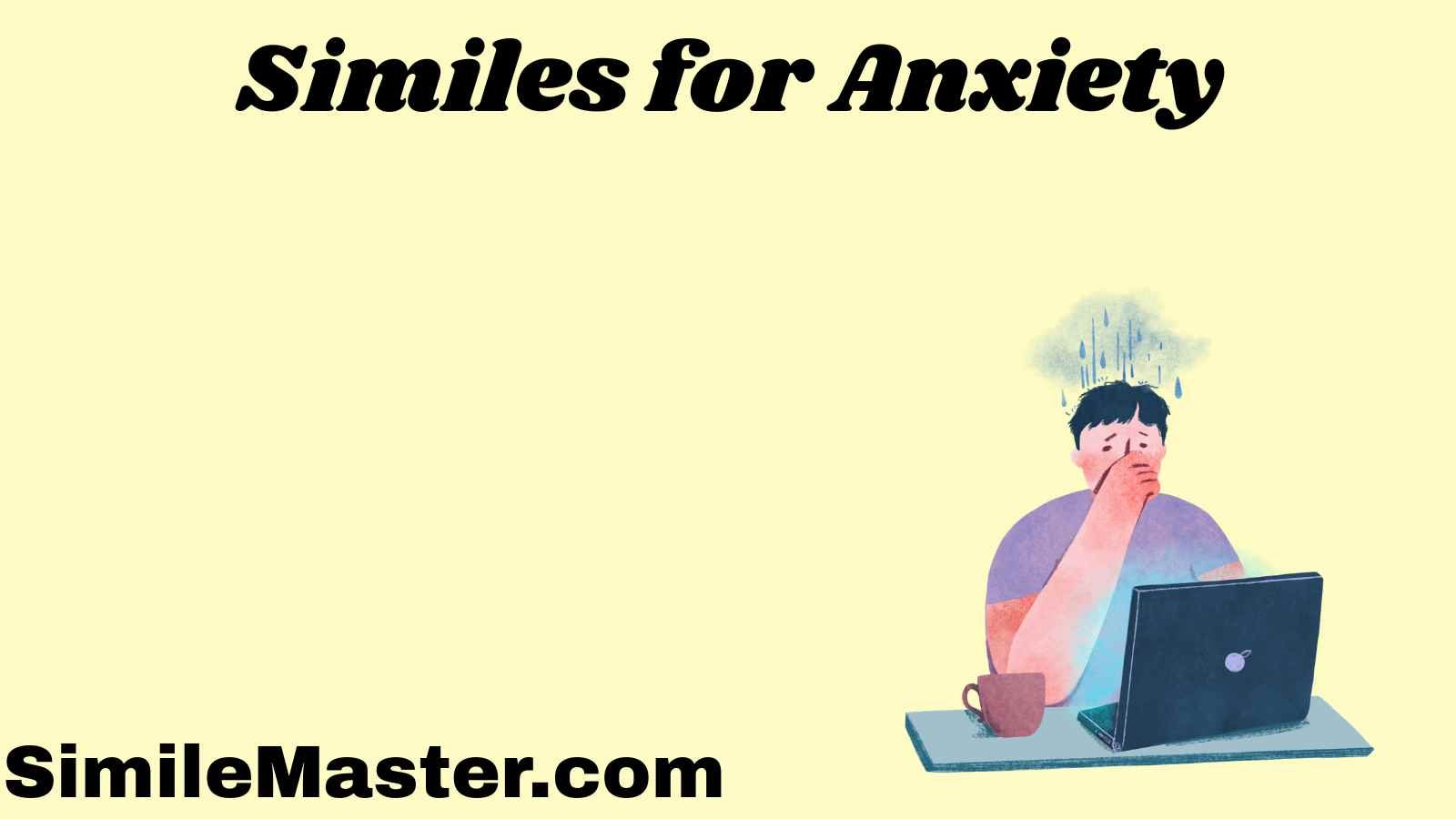
Have you ever felt so nervous before a test that your stomach started doing flips? Or waited for an important phone call while your thoughts raced faster than a speeding car? Anxiety can feel like a storm inside your mind, even when everything around you seems perfectly calm.
Finding the right words to describe these feelings can be difficult. That is where similes for anxiety become useful. A simile compares one thing to another using words such as like or as. These comparisons help readers understand emotions that are often invisible but deeply felt.
For example, saying “I felt anxious” tells readers about an emotion. However, saying “My thoughts raced like horses escaping a stable” gives them a much clearer picture of what is happening inside the character’s mind.
Whether you are a student writing an essay, a teacher preparing a classroom activity, a poet describing difficult emotions, or a storyteller creating a believable character, anxiety similes can make your writing more expressive.
In this guide, you will discover more than 60 similes for anxiety, complete with simple meanings, creative examples, school-friendly sentences, and practical writing activities. You will also learn how to create original comparisons that make nervousness, worry, fear, and uncertainty easier to describe.
Let’s turn those complicated feelings into clear, memorable words! ✨
What Are Similes for Anxiety?
Similes for anxiety are descriptive comparisons that explain feelings of worry, nervousness, tension, or uneasiness by comparing them to familiar experiences, objects, animals, or events.
A simile usually uses “like” or “as” to connect two different things.
For example:
- As nervous as a cat in a room full of dogs. This describes someone who feels uncomfortable and alert to possible danger.
- My worries were like dark clouds gathering overhead. This suggests that concerns are building and making the future feel uncertain.
- My heart pounded like a drum. This describes a rapid, forceful heartbeat during a stressful moment.
These comparisons help readers imagine emotions through physical sensations and familiar images.
Similes vs. Metaphors for Anxiety
Although similes and metaphors both describe feelings creatively, they work differently.
| Simile | Metaphor |
|---|---|
| My anxiety was like a storm. | My anxiety was a storm. |
| My thoughts raced like a train. | My thoughts were a runaway train. |
| Worry clung to me like a shadow. | Worry was my shadow. |
A simile makes a direct comparison using words such as like or as. A metaphor describes something as though it actually were something else.
Both techniques can make emotional writing more vivid.
Why Are Similes for Anxiety Important?
Anxiety is an internal feeling. Other people cannot always see it, so writers need effective ways to communicate what a worried person experiences.
Similes make those experiences easier to imagine.
1. They Make Writing More Descriptive
Instead of writing, “She was very anxious,” you might write, “Her thoughts buzzed like bees trapped inside a jar.”
The second sentence creates a stronger mental picture.
2. They Help Readers Connect With Characters
A reader might not know exactly what a character is experiencing, but a relatable comparison can help them understand the character’s emotions.
3. They Improve Creative Writing
Similes can strengthen:
- Short stories and novels
- School essays and descriptive paragraphs
- Poetry and personal narratives
- Journals and reflective writing
- Speeches and storytelling
4. They Expand Emotional Vocabulary
Anxiety can feel different from one moment to another. Sometimes it resembles a quiet whisper; at other times, it feels like a loud alarm.
Learning different comparisons helps writers distinguish mild nervousness from intense worry, uncertainty, or panic.
Remember: Anxiety similes are creative writing tools, not medical assessments. A comparison can help express an emotion, but it cannot diagnose or measure a person’s mental health.
60+ Similes for Anxiety With Meanings and Examples
The following examples cover nervousness, racing thoughts, physical tension, uncertainty, overwhelming worry, and the gradual return of calm.
1. Similes for Nervousness and Uneasiness
These comparisons work well when a character is waiting for news, meeting someone new, giving a speech, or facing an unfamiliar situation.
| # | Simile | Meaning |
|---|---|---|
| 1 | As nervous as a cat in a room full of dogs | Extremely uneasy and alert |
| 2 | As jumpy as a rabbit in tall grass | Easily startled |
| 3 | Like a leaf trembling in the wind | Feeling fragile or unsettled |
| 4 | Like a candle flickering in a draft | Feeling uncertain or unsteady |
| 5 | Like a bird trapped in a cage | Feeling restricted and distressed |
| 6 | Like a tightrope walker above a canyon | Feeling under pressure |
| 7 | As restless as a puppy before a walk | Unable to settle down |
| 8 | Like a boat rocking on choppy water | Emotionally unsettled |
| 9 | Like a deer listening for danger | Constantly alert |
| 10 | As uneasy as a stranger in a dark hallway | Feeling uncomfortable in an unfamiliar situation |
Example sentence: Before her first school presentation, Maya felt like a leaf trembling in the wind.
This comparison shows nervousness through an image readers can easily imagine.
2. Similes for Racing Thoughts and Overthinking
Sometimes anxiety makes the mind feel busy, crowded, or impossible to quiet. These similes are especially useful for inner thoughts and first-person storytelling.
| # | Simile | Meaning |
|---|---|---|
| 11 | Like a train rushing downhill | Thoughts moving too quickly |
| 12 | Like bees buzzing inside a jar | A mind full of restless thoughts |
| 13 | Like a hamster running on a wheel | Repeating the same thoughts |
| 14 | Like a radio changing stations too quickly | Difficulty focusing |
| 15 | Like a computer with too many tabs open | Feeling mentally overloaded |
| 16 | Like leaves swirling in a whirlwind | Thoughts moving in every direction |
| 17 | Like a river racing over rocks | Thoughts flowing rapidly |
| 18 | Like a clock ticking louder with every second | Growing preoccupation with time |
| 19 | Like a tangled ball of yarn | Confused and complicated thinking |
| 20 | Like a record stuck on the same line | Repeatedly thinking about one concern |
Example sentence: The night before the exam, my thoughts raced like a train rushing downhill.
The comparison suggests that the narrator is struggling to slow down their thinking.
3. Similes for Physical Signs of Anxiety
Anxiety is not always expressed through thoughts alone. Writers can also describe a character’s heartbeat, breathing, hands, stomach, or muscles.
| # | Simile | Meaning |
|---|---|---|
| 21 | My heart pounded like a drum | A strong, rapid heartbeat |
| 22 | My stomach twisted like a knotted rope | A nervous stomach sensation |
| 23 | My hands shook like leaves in a storm | Trembling from nervousness |
| 24 | My knees felt like jelly | Feeling physically unsteady |
| 25 | My breath came like short waves against the shore | Uneven or shallow breathing |
| 26 | My muscles felt as tight as stretched rubber bands | Physical tension |
| 27 | My voice trembled like a violin string | Speaking nervously |
| 28 | My fingers tapped like raindrops on a window | Restless movement |
| 29 | My chest felt like a drum being struck too hard | A vivid description of chest discomfort |
| 30 | My skin prickled like grass beneath a sudden breeze | Feeling tense or unusually alert |
Example sentence: When the teacher called my name, my hands shook like leaves in a storm.
This sentence communicates nervousness without simply naming the emotion.
Writing note: These are figurative descriptions, not symptoms everyone experiences. If you are describing real, severe, or new chest discomfort or difficulty breathing, do not assume anxiety is the cause.
4. Similes for Fear of the Unknown
Uncertainty can make ordinary situations feel threatening. These comparisons suit stories about waiting for results, facing change, or anticipating an important decision.
| # | Simile | Meaning |
|---|---|---|
| 31 | Like walking through fog without a map | Not knowing what lies ahead |
| 32 | Like standing before a closed door | Waiting to discover what happens next |
| 33 | Like sailing into an unknown sea | Facing uncertainty |
| 34 | Like walking on ice that might crack | Feeling insecure |
| 35 | Like standing beneath a darkening sky | Expecting something difficult |
| 36 | Like following a path with no signs | Being unsure what to do |
| 37 | Like hearing footsteps in an empty house | Feeling uneasy about an unexplained situation |
| 38 | Like holding a letter you are afraid to open | Dreading possible news |
| 39 | Like waiting for thunder after seeing lightning | Anticipating an unpleasant event |
| 40 | Like standing at the edge of a deep forest | Feeling uncertain about what comes next |
Example sentence: Waiting for the results felt like holding a letter I was afraid to open.
The comparison expresses anticipation and worry without revealing whether the results will be good or bad.
5. Similes for Overwhelming Anxiety and Pressure
These similes describe moments when worries seem difficult to manage or responsibilities feel too heavy.
| # | Simile | Meaning |
|---|---|---|
| 41 | Like carrying a mountain on my shoulders | Feeling heavily burdened |
| 42 | Like being caught in a powerful storm | Feeling overwhelmed |
| 43 | Like drowning in a sea of thoughts | Feeling consumed by worries |
| 44 | Like a balloon stretched close to bursting | Feeling under intense pressure |
| 45 | Like a small boat facing giant waves | Feeling vulnerable |
| 46 | Like a fire alarm ringing inside my head | Feeling intensely alarmed |
| 47 | Like being trapped in a room with shrinking walls | Feeling increasingly confined |
| 48 | Like carrying a glass of water across a shaking bridge | Trying hard not to lose control |
| 49 | Like a snowball rolling down a hill | Watching worries grow larger |
| 50 | Like standing beneath a waterfall of unanswered questions | Feeling flooded by uncertainty |
Example sentence: With three deadlines approaching, I felt like carrying a mountain on my shoulders.
This image makes an invisible emotional burden easier to picture.
6. Similes for Quiet Worry and Hidden Anxiety
Not everyone shows anxiety openly. Some people appear calm while quietly worrying about what might happen.
| # | Simile | Meaning |
|---|---|---|
| 51 | Like a quiet storm beneath a still lake | Hidden emotional turmoil |
| 52 | Like a tiny alarm ringing in the distance | A subtle sense of concern |
| 53 | Like a shadow following every step | Persistent worry |
| 54 | Like a pebble in a shoe | A small but constant discomfort |
| 55 | Like a clock ticking in an empty room | A quiet, persistent sense of pressure |
| 56 | Like a thread pulling at the edge of a sweater | A small concern that keeps demanding attention |
| 57 | Like a cloud covering a corner of the sky | A lingering uneasy feeling |
| 58 | Like a whisper behind a closed door | A worry that stays in the background |
| 59 | Like ripples spreading across still water | A small concern gradually affecting other thoughts |
| 60 | Like a knot hidden beneath a smooth surface | Tension that others cannot easily see |
Example sentence: Although Daniel smiled at his friends, his worry followed him like a shadow.
This simile works well when describing a character who hides their feelings from others.
7. Bonus Similes for Relief and Returning Calm
Anxiety writing does not always need to end with fear. These additional comparisons describe a character beginning to feel calmer.
| # | Simile | Meaning |
|---|---|---|
| 61 | Like clouds parting after a storm | Worry beginning to lift |
| 62 | Like a pond settling after a stone is dropped | Thoughts gradually becoming quieter |
| 63 | Like a bird resting after a long flight | Finding a moment of rest |
| 64 | Like a sailboat entering a sheltered bay | Reaching a safer, calmer situation |
| 65 | Like a tangled string slowly coming loose | Confusion gradually easing |
| 66 | Like warm sunlight spreading across a cold room | Feeling comforted |
| 67 | Like a gentle breeze after a hot day | Experiencing relief |
| 68 | Like a spinning wheel slowing to a stop | Thoughts gradually settling |
Example sentence: After talking to her teacher, the worries in Ella’s mind began to settle like a pond after a stone is dropped.
These comparisons can create a hopeful ending without suggesting that difficult emotions always disappear immediately.
Fun and Creative Similes for Anxiety
Sometimes the most memorable descriptions are unusual, playful, or slightly exaggerated. These similes can make creative writing more vivid while keeping the emotion understandable.
- My worries multiplied like rabbits in a garden.
- My brain buzzed like a beehive during lunchtime.
- Waiting for my turn felt like standing on a stage made of wobbling jelly.
- My nerves danced like popcorn in a hot pan.
- My thoughts chased each other like puppies around a yard.
- My confidence shrank like a sweater in hot water.
- My imagination ran wild like a horse across an open field.
- My excuses piled up like dirty dishes after a party.
- My stomach fluttered like a paper kite in a gusty wind.
- My mind spun like a carousel that would not slow down.
- My patience melted like an ice cube on a summer sidewalk.
- My nervous energy bounced around like a rubber ball in a tiny room.
When Should You Use Funny Anxiety Similes?
Playful comparisons are useful when writing lighthearted school stories, humorous personal essays, or characters who use jokes to cope with nervousness.
For example:
Before the spelling bee, Omar’s nerves bounced around like a rubber ball in a tiny room.
The sentence feels lively and relatable without making fun of someone who experiences serious anxiety.
Similes for Anxiety in School and the Classroom
School offers many situations in which students may feel nervous, from answering questions to taking exams or making new friends.
Here are 10 classroom-friendly examples.
- Before a test: My thoughts scattered like papers in a strong wind.
- During a presentation: My voice shook like a small branch in a breeze.
- When called on unexpectedly: My heart jumped like a fish out of water.
- While waiting for grades: The minutes crawled like snails across a garden path.
- On the first day of school: I felt like a new student stepping into a giant maze.
- Before a spelling bee: My stomach fluttered like a flag in the wind.
- When solving a difficult problem: My mind felt like a puzzle with missing pieces.
- Before meeting classmates: I felt like a little bird testing its wings.
- When submitting homework late: The thought weighed on me like a heavy backpack.
- After receiving encouragement: My confidence returned like sunlight after rain.
Short Paragraph Using Anxiety Similes
On the morning of the science fair, Aisha felt like a boat rocking on choppy water. Her thoughts raced like a train, and her hands shook like leaves in a storm. When her teacher smiled and reminded her to take her time, the tension slowly eased. Aisha took a steady breath and walked toward her project table. She still felt nervous, but her fear no longer seemed like a mountain standing in her way.
This paragraph uses several comparisons to show a change in emotion rather than simply telling readers that Aisha felt anxious.
A Mini Story: The Speech That Felt Like a Storm
Rayan had practiced his speech for a week. He knew every sentence, every example, and even the joke he planned to tell at the end.
But when he stood outside the classroom, his confidence seemed to disappear.
His stomach twisted like a knotted rope. His heart pounded like a drum, and his thoughts raced like cars on a busy highway. Through the classroom window, he could see his classmates waiting.
“What if I forget everything?” he wondered.
The question followed him like a shadow.
His teacher noticed his worried expression and approached him.
“You don’t have to be perfect,” she said. “Just begin with the first sentence.”
Rayan took a slow breath. His anxiety was still there, like a storm moving across the horizon, but he decided to open the door anyway.
He walked to the front of the room and began speaking. His voice trembled at first, like a violin string in a breeze. Then he remembered his practice. One sentence became two, and two became a paragraph.
By the end, his classmates were smiling.
Rayan returned to his seat feeling lighter, as if a heavy backpack had finally been lifted from his shoulders.
He had not needed to become completely fearless. He had simply needed to take the next step.
What Can Writers Learn From This Story?
The story uses similes to show several stages of anxiety:
- Anticipation: Worry follows Rayan like a shadow.
- Physical tension: His heart pounds like a drum.
- Mental pressure: His thoughts race like cars on a highway.
- Courage: He takes action despite feeling nervous.
- Relief: He feels as if a heavy backpack has been lifted.
This emotional progression makes the character feel more realistic and gives readers a reason to care about the outcome.
Interactive Activities: Practice Describing Anxiety
Try these short activities to build your descriptive writing skills.
Activity 1: Match the Simile to Its Meaning
Match each comparison with the best explanation.
| Simile | Meaning |
|---|---|
| 1. Like a hamster running on a wheel | A. Feeling burdened |
| 2. Like carrying a mountain | B. Repeating the same thoughts |
| 3. Like a leaf in the wind | C. Feeling unsettled |
| 4. Like clouds parting after a storm | D. Beginning to feel better |
Answers: 1–B, 2–A, 3–C, 4–D.
Activity 2: Improve These Sentences
Rewrite each sentence using a simile.
- I was nervous before the exam.
- Her thoughts would not stop.
- He felt overwhelmed by his responsibilities.
- She was worried while waiting for the phone call.
- I began to feel calm after talking to my friend.
Possible answers:
- I was as nervous as a rabbit listening for danger before the exam.
- Her thoughts buzzed like bees inside a jar.
- He felt like he was carrying a mountain on his shoulders.
- Waiting for the phone call felt like holding a letter I was afraid to open.
- After talking to my friend, my mind began to settle like a pond after a stone is dropped.
Other original answers are welcome if they communicate the intended feeling clearly.
Activity 3: Create Your Own Anxiety Simile
Use this simple formula:
Feeling + like/as + familiar object, animal, place, or event
For example:
- Feeling: nervous
- Familiar image: a bird in a cage
- Simile: My nervousness felt like a bird fluttering inside a cage.
Now complete these prompts:
- My thoughts raced like __________.
- My hands trembled like __________.
- My worry followed me like __________.
- My anxiety felt as heavy as __________.
- My mind grew calmer like __________.
Try to choose comparisons that fit your specific feeling rather than simply selecting the first image that comes to mind.
Practice Worksheet: Similes for Anxiety
Test your understanding with the following questions.
Part A: Fill in the Blanks
Choose the best word or phrase for each sentence.
- My heart pounded like a __________. (drum / pillow)
- My thoughts buzzed like __________ in a jar. (bees / stones)
- Waiting for the results felt like holding a letter I was afraid to __________. (open / paint)
- My worries followed me like a __________. (shadow / rainbow)
- After the good news, the clouds began to __________. (part / multiply)
Part B: Multiple-Choice Quiz
6. Which sentence contains a simile?
A. My anxiety was a storm.
B. My anxiety felt like a storm.
C. My anxiety increased.
7. Which simile best describes repetitive overthinking?
A. Like a hamster running on a wheel.
B. Like sunlight on a garden.
C. Like a bird resting on a branch.
8. Which comparison best describes uncertainty?
A. Like walking through fog without a map.
B. Like eating a delicious meal.
C. Like watching a clear blue sky.
9. Which sentence describes relief?
A. My worries grew like weeds.
B. My thoughts raced like a train.
C. My mind settled like a pond after a stone is dropped.
10. Which is the best way to create an original simile?
A. Repeat a familiar phrase in every paragraph.
B. Choose an image that matches the specific emotion.
C. Add as many comparisons as possible to every sentence.
Answer Key
- Part A: 1. drum; 2. bees; 3. open; 4. shadow; 5. part.
- Part B: 6. B; 7. A; 8. A; 9. C; 10. B.
Give yourself one point for each correct answer. If you missed any questions, revisit the examples and notice how the comparison connects to the emotion.
Common Mistakes When Using Anxiety Similes
Similes can strengthen writing, but only when they make the intended feeling clearer.
1. Using a Comparison That Does Not Fit
Weak example: My anxiety was like a delicious sandwich.
This could work in an unusual humorous context, but it does not naturally communicate worry.
Improved example: My anxiety felt like a storm gathering over the sea.
The second comparison creates a recognizable image of tension and uncertainty.
2. Confusing Similes With Metaphors
A simile uses like or as to make a comparison.
- Simile: My thoughts raced like a train.
- Metaphor: My thoughts were a runaway train.
Both are valid forms of figurative language, but they are not the same.
3. Overusing Similar Comparisons
Using storms, racing hearts, and dark clouds in every paragraph can make descriptions repetitive.
Instead, vary your imagery. A character might experience anxiety as a tangled knot in one scene and as a ticking clock in another.
4. Making Every Feeling Extreme
Not all anxiety feels like drowning or standing in a hurricane. Sometimes it is a small, persistent concern, like a pebble in a shoe.
Choose the intensity of your comparison to match the character’s situation.
5. Telling Instead of Showing
The sentence I was nervous is not wrong. Sometimes direct language is exactly what a writer needs.
However, when a scene requires stronger emotional detail, you can combine direct language with a simile:
I was nervous, and my fingers tapped like raindrops against the desk.
The reader gets both a clear statement and a vivid image.
6. Forgetting the Context
A good simile should fit the character, setting, audience, and mood. A funny comparison may suit a children’s story, while a quieter comparison may be better for a serious personal narrative.
The goal is not to make every sentence dramatic. It is to help readers understand the feeling more clearly.
Frequently Asked Questions About Similes for Anxiety
1. What is a good simile for anxiety?
A good simile is “My worries were like dark clouds gathering overhead.” It describes anxiety as something that gradually builds and makes the future seem uncertain.
Another effective example is “My thoughts raced like a train,” which communicates rapid, difficult-to-settle thinking.
2. What are some similes for feeling nervous?
Examples include:
- As nervous as a cat in a room full of dogs.
- Like a leaf trembling in the wind.
- Like a tightrope walker above a canyon.
- My heart pounded like a drum.
- My knees felt like jelly.
These comparisons work well for exams, speeches, competitions, and unfamiliar situations.
3. How do you describe anxiety in creative writing?
Start by identifying how the character experiences the emotion. Is the character overthinking, feeling physically tense, worrying about the future, or hiding their concern?
Then choose a related image. For racing thoughts, you might use a runaway train. For uncertainty, you might use fog on an unfamiliar road.
Finally, place the simile in a sentence that fits the scene.
4. What is the difference between a simile for anxiety and a metaphor for anxiety?
A simile makes a comparison using words such as like or as. For example, “Anxiety felt like a storm.”
A metaphor describes anxiety directly as something else: “Anxiety was a storm.”
Both can communicate strong emotions, but similes make the comparison more explicit.
5. Can children use anxiety similes in school assignments?
Yes. Simple examples are often best for younger students.
For instance, “My stomach fluttered like a butterfly,” or “My thoughts raced like a train.” These comparisons use familiar images and help children practice figurative language.
Teachers can ask students to identify the feeling, underline the comparison, and create a simile of their own.
6. Can similes help describe hidden anxiety?
Yes. Comparisons such as “Worry followed me like a shadow” or “My mind held a quiet storm beneath a still lake” can show that a character feels uneasy even when they appear calm.
These descriptions are useful in fiction and personal narratives, although a single outward behavior cannot tell us exactly what another person is feeling.
Conclusion
Anxiety can be difficult to explain, but the right words can make complicated feelings easier to understand. From a racing train of thoughts to a storm gathering on the horizon, similes give writers familiar images for experiences that may otherwise feel invisible.
The 68 examples in this guide can help you describe nervousness, overthinking, physical tension, uncertainty, overwhelming pressure, hidden worry, and the gradual return of calm.
As you write, remember three simple principles:
- Choose an image that matches the emotion.
- Keep your comparison clear and appropriate for your audience.
- Use similes where they add meaning, not merely to decorate every sentence.
Most importantly, experiment with your own ideas. A familiar comparison can be effective, but an original one can make your writing especially memorable.
Your turn: Think of a moment when you felt nervous, uncertain, or overwhelmed. What did that feeling remind you of? Perhaps it was a clock ticking in an empty room, a boat drifting through fog, or a small bird testing its wings.
Turn that image into a simile, and you have taken the first step toward more expressive writing. 🌱